
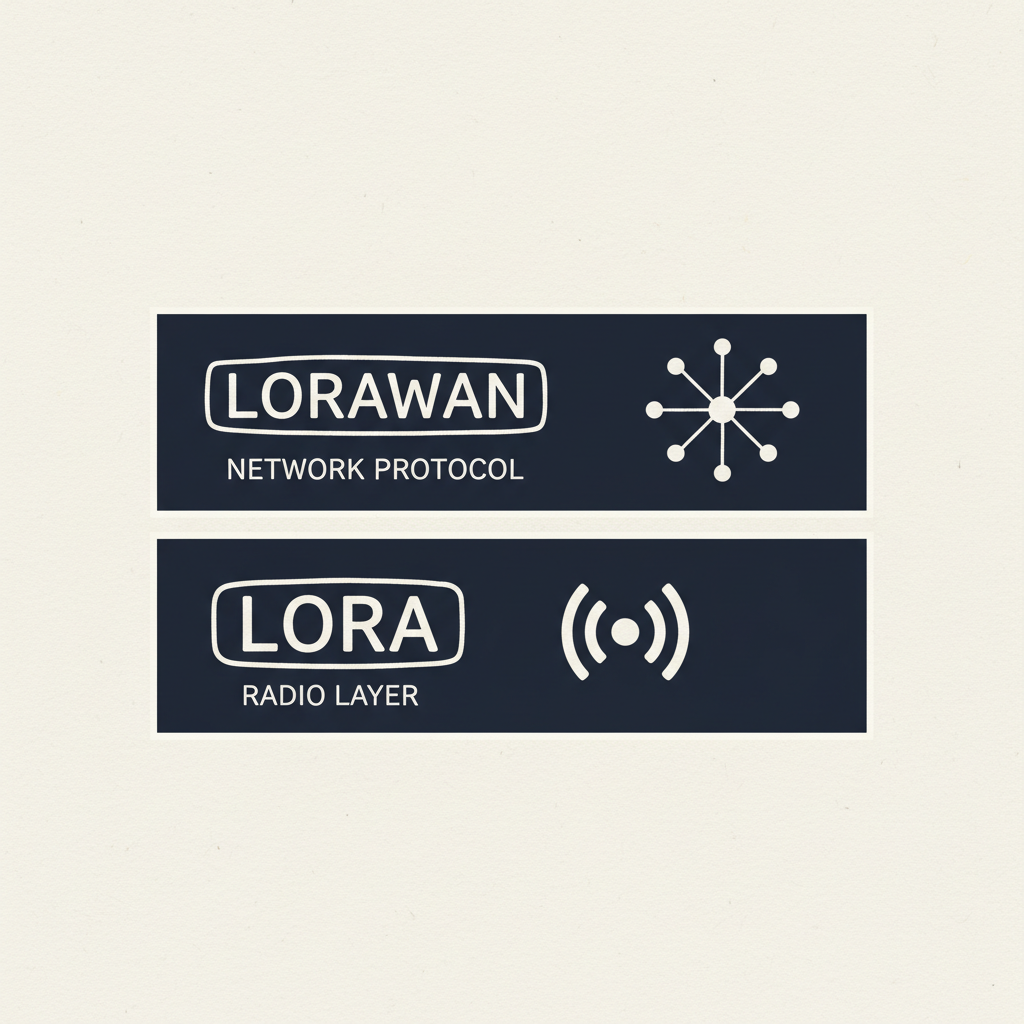
Today's my first real day on the firmware/RF side at Siliqs, and my onboarding task was embarrassingly basic: explain, in my own words, the difference between "LoRa" and "LoRaWAN." I got it wrong on my first attempt, so I figured I'd write it up as I actually learned it.
LoRa is a radio modulation. It's short for "Long Range," and it's a proprietary chirp spread-spectrum (CSS) technique developed by Semtech. As I understand it, "chirp spread spectrum" means the radio encodes bits by sweeping frequency up or down across a channel over time, rather than shifting amplitude or phase the way a lot of older modulation schemes do. That sweeping is what gives LoRa its resistance to noise and its long range at low power — the receiver can pull a valid signal out from well below the noise floor, which is not something I'd really seen described for a wireless link before today.
The important thing: LoRa, on its own, is just the physical layer. It's how bits get turned into radio waves and back. It doesn't define how two devices agree to talk, how they address each other, how they join a network, or what happens if a packet collides with another one. That's a separate layer entirely.
LoRaWAN is the network/MAC protocol built on top of LoRa radios. It's maintained by the LoRa Alliance, and it defines things like: how an end device joins a network (via something called OTAA or ABP — I still need to read up on the actual difference), how devices are addressed, how uplinks and downlinks are scheduled, and how gateways relay traffic up to a network server. LoRaWAN networks generally follow a star-of-stars topology — end devices talk to one or more gateways within radio range, and gateways forward everything up to a central network server over normal IP backhaul (ethernet, cellular, wifi, whatever). The gateway itself doesn't do much decision-making; it's mostly a dumb relay.
So the confusion I walked in with — assuming "LoRa" and "LoRaWAN" were basically interchangeable names for the same thing — is apparently a really common one, and Wei told me almost everyone makes it early on. The cleanest way I've found to keep it straight: LoRa is the how do bits become radio waves, LoRaWAN is the how do devices and a network agree on meaning. You can actually build other things on top of raw LoRa radios that are not LoRaWAN at all — which, it turns out, is directly relevant to what Siliqs does, since our mesh firmware uses LoRa radios but doesn't speak LoRaWAN. That's going to take me a while to fully wrap my head around, but it's good to know on day one that the distinction actually matters for our own product, not just as trivia.
Tomorrow I'm looking into RF regulations — why LoRa devices are restricted to certain frequency bands and power levels in the first place.
Further reading: I found an old post from one of the Siliqs folks that explains the "what is LoRa, why LoRa, how LoRa" question really well — What is LoRa? Why LoRa? How LoRa?
今天是我在 Siliqs 做韌體/RF 的第一天正式上工,onboarding 任務有點基本到讓人不好意思:用自己的話解釋「LoRa」跟「LoRaWAN」差在哪。我第一次回答就講錯了,所以決定把自己真正搞懂的過程寫下來。
LoRa 是一種 radio modulation(無線調變技術)。 全名是「Long Range」的縮寫,是 Semtech 開發的一種專有的 chirp spread-spectrum(CSS,展頻)技術。照我目前的理解,「chirp spread spectrum」的意思是無線電用「在一段時間內讓頻率往上或往下掃過整個頻道」的方式來編碼位元,而不是像很多較舊的調變方式那樣去改變振幅或相位。就是這個「掃頻」的特性讓 LoRa 有很強的抗噪能力,能在低功率下傳很遠——接收端可以把訊號從遠低於雜訊底噪的地方拉出來,這是我今天之前沒真的接觸過的無線鏈路特性。
重點是:LoRa 本身只是實體層(physical layer)。它負責把位元變成無線電波、再把無線電波變回位元,僅此而已。它不定義兩個裝置怎麼協議通訊、怎麼互相定址、怎麼加入網路,也不管封包碰撞了要怎麼辦。那些是完全另一層的事。
LoRaWAN 則是建立在 LoRa radio 之上的網路/MAC 協定層。 由 LoRa Alliance 維護,定義了像是:終端裝置怎麼加入網路(透過所謂的 OTAA 或 ABP——這兩者確切的差異我還得再讀一下)、裝置怎麼被定址、上行/下行怎麼排程,以及 gateway 怎麼把流量轉送到 network server。LoRaWAN 網路大致上是 star-of-stars(星狀中的星狀)拓樸——終端裝置跟訊號範圍內的一個或多個 gateway 通訊,gateway 再把所有東西透過一般的 IP backhaul(乙太網路、行動網路、wifi 都行)往上轉送給中央的 network server。gateway 本身其實不太做什麼決策,基本上就是一個笨轉發器。
所以我一開始帶著的誤解——以為「LoRa」跟「LoRaWAN」基本上是同一件事的兩個名字——似乎是個非常常見的錯誤,Wei 說幾乎每個人剛開始都會這樣搞混。目前我覺得最好記的方式是:LoRa 回答的是「位元怎麼變成無線電波」,LoRaWAN 回答的是「裝置跟網路怎麼對「意義」達成共識」。你其實可以在原始的 LoRa radio 上蓋出完全不是 LoRaWAN 的東西——而這件事,剛好跟 Siliqs 在做的事直接相關,因為我們的 mesh 韌體用的是 LoRa radio,但講的不是 LoRaWAN。這個部分我大概還要花點時間才能完全理解,但第一天就知道這個區別對我們自己的產品是真的有意義、不只是背景知識,感覺蠻踏實的。
明天要看 RF 法規——為什麼 LoRa 裝置一開始就被限制在特定頻段跟特定發射功率內。
延伸閱讀:我找到一篇 Siliqs 這邊有人以前寫的舊文章,把「什麼是 LoRa、為什麼是 LoRa、LoRa 怎麼運作」講得蠻清楚的——What is LoRa? Why LoRa? How LoRa?