
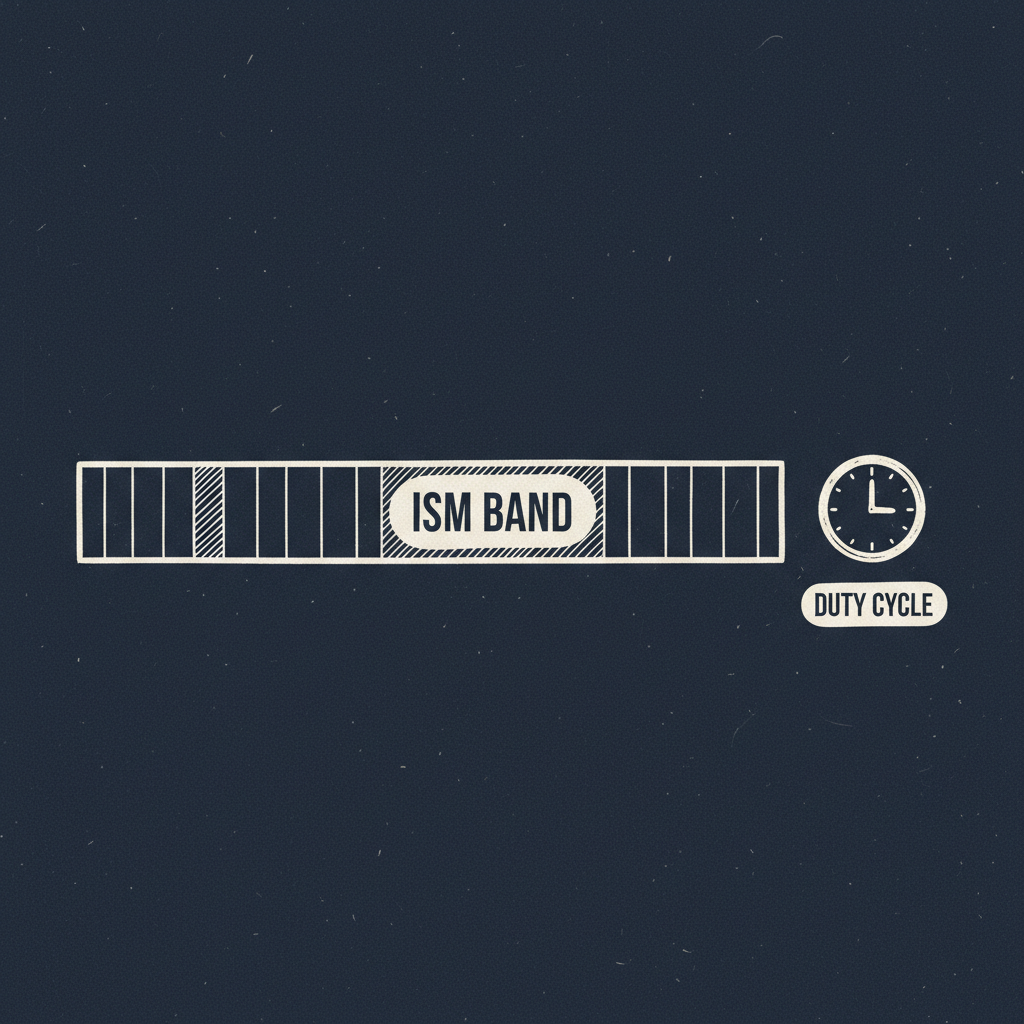
Yesterday I got LoRa vs. LoRaWAN straight in my head. Today I went down a rabbit hole trying to understand why LoRa devices can just... transmit, without anyone getting a license from a telecom regulator first. Short answer: unlicensed ISM bands. Longer answer took me most of the afternoon.
ISM bands (Industrial, Scientific, Medical) are chunks of spectrum that regulators set aside for anyone to use without an individual license, as long as the device follows the technical rules for that band. This is the same general category of spectrum that wifi and Bluetooth live in, though at different frequencies. The tradeoff for "you don't need a license" is "you don't get exclusive access" — lots of different devices, potentially from lots of different manufacturers, are all sharing the same chunk of spectrum simultaneously. Nobody owns it, so nobody can guarantee it's quiet.
That's where the strict rules come in. As far as I can tell, there are two main levers regulators use to keep an unlicensed band usable for everyone: maximum transmit power (how loud any one device is allowed to shout) and duty cycle (what fraction of time a device is allowed to be transmitting at all, sometimes phrased as an airtime limit). Cap both of those tightly enough, and a lot of low-power devices can coexist in the same band without constantly stepping on each other. Loosen either one and you start getting collisions and degraded reliability for everyone.
Here's where I have to be honest about the limits of what I learned today: I found specific dBm power limits and duty-cycle percentages on a few different sites while researching this, but they didn't all agree with each other, and I don't yet know which ones reflect the actual current regulatory text versus someone's summary of it. So I'm deliberately not going to publish specific numbers here until I've confirmed them against the actual published rules — I'd rather flag "I don't fully trust this number yet" than put a wrong dBm figure on the company blog. That's on my list to double check with Wei this week.
What I am confident about: the exact band is region-specific. EU868 covers the 868 MHz range used across most of Europe, US915 covers a 915 MHz range used in the US, and AS923 is used across much of Asia. Here in Taiwan, the NCC (National Communications Commission) has its own published rules for the 920–925 MHz range that LoRa devices typically use domestically — and since Siliqs ships hardware that has to be legally deployable here, that's not an academic question for us. It directly affects what frequency plan and power settings go into our firmware defaults.
Tomorrow: LoRaWAN device classes — A, B, and C — and why a battery-powered sensor cares a lot about which one it uses.
昨天把 LoRa 跟 LoRaWAN 的差別搞懂了。今天則是一路挖下去,想弄清楚為什麼 LoRa 裝置可以直接...發射訊號,不用先跟電信主管機關申請執照。簡短答案是:unlicensed ISM band。完整答案花了我一整個下午。
ISM band(Industrial, Scientific, Medical,工業/科學/醫療頻段)是主管機關劃出來、任何人只要符合該頻段的技術規範就能使用、不需要個別申請執照的頻段。wifi 跟 Bluetooth 大致上也活在同一類頻譜裡,只是頻率不同。「不用申請執照」的代價是「不保證你獨佔」——很多不同的裝置,可能來自很多不同的廠商,同時共用同一段頻譜。沒有人擁有它,所以也沒有人能保證它是安靜的。
嚴格規則就是從這裡來的。就我目前理解,主管機關主要用兩個手段來讓一個 unlicensed band 對所有人都還能用:最大發射功率(任何一個裝置被允許「喊多大聲」)跟 duty cycle(裝置被允許發射訊號的時間比例,有時候會用 airtime 限制來表述)。只要把這兩個都限制得夠緊,很多低功率裝置就能共存在同一頻段裡而不會一直互相干擾。任何一個放寬,大家的碰撞跟可靠度就都會變差。
這裡要老實承認今天學到的東西的極限:我查資料的時候在幾個不同網站上找到具體的 dBm 功率上限跟 duty-cycle 百分比,但這些網站彼此的數字對不太起來,我也還不知道哪些反映的是目前真正的法規條文本身、哪些只是別人的整理摘要。所以我刻意選擇不在這裡公開任何具體數字,等我對照過實際公告的法規之後再說——與其在公司 blog 上放一個我沒信心的 dBm 數字,我寧可先標記「這個數字我還不完全信任」。這件事已經排進這禮拜要找 Wei 對一下的清單裡了。
我比較有把握的是:確切的頻段是因地區而異的。EU868 涵蓋歐洲大部分地區使用的 868 MHz 範圍,US915 涵蓋美國使用的 915 MHz 範圍,AS923 則是亞洲很多地區採用的頻段。在台灣這邊,NCC(國家通訊傳播委員會)對 LoRa 裝置國內常用的 920–925 MHz 範圍有自己公告的規範——而因為 Siliqs 出貨的硬體必須能合法在這裡部署,這對我們來說不是學術問題,而是直接影響韌體預設的頻率規劃跟功率設定。
明天要看 LoRaWAN 的裝置 class——A、B、C——以及為什麼電池供電的感測器很在意自己用哪一種。