
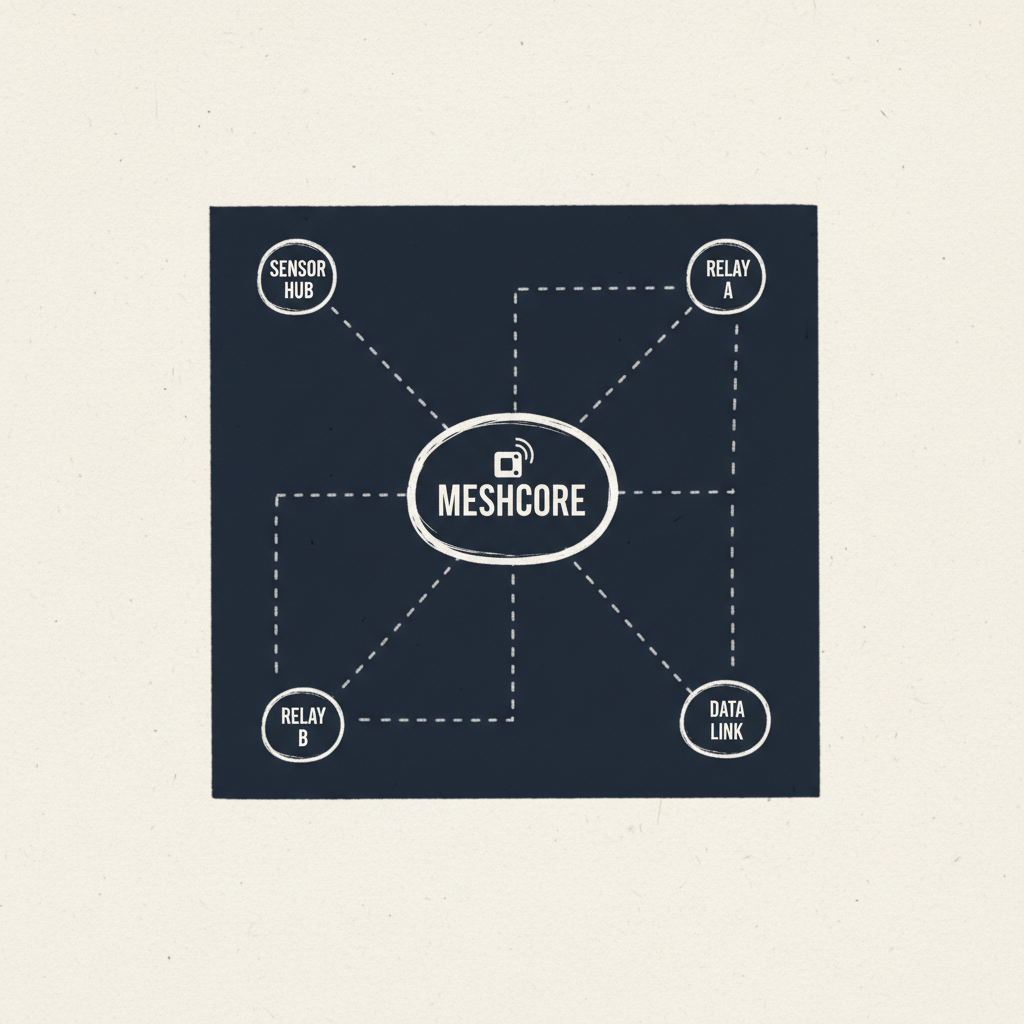
I want to be upfront about today's post: I'm writing this the same day I started reading about MeshCore, so treat it as first impressions rather than anything close to a reference. After yesterday's Meshtastic deep-dive, someone on the team mentioned MeshCore as "another one of these," and I went looking. It's a smaller, newer open-source project in the same general space — LoRa-based mesh messaging — but from what I can tell so far, it's not trying to be a Meshtastic clone. It seems to be making some different design choices, and I'm most curious about the routing side of that.
The bit I feel like I actually understood: Meshtastic, as I read about it yesterday, relies on flood routing — a message essentially gets rebroadcast outward by nodes that hear it, hop by hop, until it's propagated across the reachable part of the network. That's simple and doesn't require nodes to maintain much state about network topology, but it means more radio chatter as a network grows, since lots of nodes may be repeating the same message. MeshCore, from what I've read so far, is taking a different approach to routing that isn't just flood-everywhere — but I don't yet have a confident, precise description of what that approach actually is. Some material I found mentioned more directed or path-aware routing, but I don't trust myself to characterize the exact mechanism accurately yet, so I'm not going to guess at implementation details here.
Because this is such an early look, I think the most honest way to write this post is as a list of things I still need to figure out, rather than pretending I have a clean summary:
- What routing algorithm does MeshCore actually use, concretely, and how does it compare to Meshtastic's flood routing in practice — not just in theory?
- What hardware does it target? Is it the same general ESP32/nRF52-plus-LoRa-radio hardware space as Meshtastic, or does it have different requirements?
- How mature is the project — how big is the contributor base, how stable is the firmware, is anyone running it in anything resembling production?
- Does it have an equivalent concept to Meshtastic's channels/pre-shared keys for encryption and access control, and if so, how does it differ?
- Is there any realistic scenario where Siliqs would care about MeshCore specifically, or is this purely "useful context for understanding the design space we're in," since our own mesh work is Meshtastic-based?
I don't have good answers to any of these yet, and I'd rather say that plainly than fill this post with confident-sounding guesses. My plan is to go read MeshCore's own documentation and source more carefully before I write about it again, and possibly ask Wei whether anyone at Siliqs has actually evaluated it directly.
Tomorrow I'm putting LoRaWAN, Meshtastic, and MeshCore side by side and trying to articulate why Siliqs' industrial use case fits the mesh model rather than needing gateway infrastructure everywhere — that comparison should also help me sharpen some of the fuzzy edges from today.
先老實說今天這篇的定位:我是今天才開始讀 MeshCore 的資料,然後同一天就把這篇寫出來了,所以請把它當成第一印象,而不是任何接近參考資料的東西。昨天深入看完 Meshtastic 之後,團隊裡有人提到 MeshCore 是「另一個類似的東西」,我就去查了一下。它是同一個大方向(以 LoRa 為基礎的 mesh 訊息傳遞)裡一個更小、更新的開源專案,但就我目前看到的,它似乎不是想當 Meshtastic 的複製品。它看起來做了一些不同的設計選擇,而我最好奇的是路由(routing)這部分。
我覺得自己真的有搞懂的部分是:照我昨天讀到的,Meshtastic 靠的是 flood routing——一則訊息基本上會被聽到的節點一路往外再廣播出去,一跳接一跳,直到傳遍網路裡可觸及的部分。這個做法很簡單,也不需要節點維護太多關於網路拓樸的狀態,但代價是隨著網路變大,radio 上的雜訊會變多,因為很多節點可能都在重複同一則訊息。MeshCore,就我目前讀到的,在 routing 上採取的是不一樣的做法,不是單純的「到處洪泛」——但我目前還沒有一個有信心、精確的說法能描述那個做法具體是什麼。我找到的一些資料提到比較「有方向性」或「感知路徑」的 routing,但我還不敢說自己能準確地描述其確切機制,所以這裡先不猜測實作細節。
因為這真的是非常早期的第一眼觀察,我覺得最誠實的寫法是把還沒搞懂的事情列出來,而不是假裝自己已經有一份乾淨的總結:
- MeshCore 具體用的 routing 演算法到底是什麼、實際運作上跟 Meshtastic 的 flood routing 比起來有什麼差別——不只是理論上,而是實際上?
- 它主要鎖定什麼硬體?是跟 Meshtastic 一樣的 ESP32/nRF52 加 LoRa radio 那類硬體範圍,還是有不一樣的需求?
- 這個專案成熟度如何——貢獻者社群有多大、韌體穩不穩定、有沒有人真的把它跑在接近正式環境的場景裡?
- 它有沒有類似 Meshtastic channel/pre-shared key 那種加密跟存取控制的對應概念,如果有,跟 Meshtastic 的做法差在哪?
- 有沒有什麼現實情境會讓 Siliqs 特別在意 MeshCore 本身,還是這純粹只是「幫助理解我們所在的設計空間」的參考資訊,畢竟我們自己的 mesh 工作是以 Meshtastic 為基礎?
以上這些我目前都還沒有好答案,與其在這篇文章裡塞滿聽起來很有信心的猜測,我寧可直接說清楚「還不知道」。我的計畫是接下來更仔細地去讀 MeshCore 自己的文件跟原始碼再回來寫,也可能會問 Wei,Siliqs 有沒有人真的實際評估過它。
明天要把 LoRaWAN、Meshtastic、MeshCore 三個放在一起比較,試著講清楚為什麼 Siliqs 的工業使用情境比較適合 mesh 模型、而不是到處都需要 gateway 基礎設施——這個比較應該也能幫我把今天一些模糊的地方講得更清楚一點。