
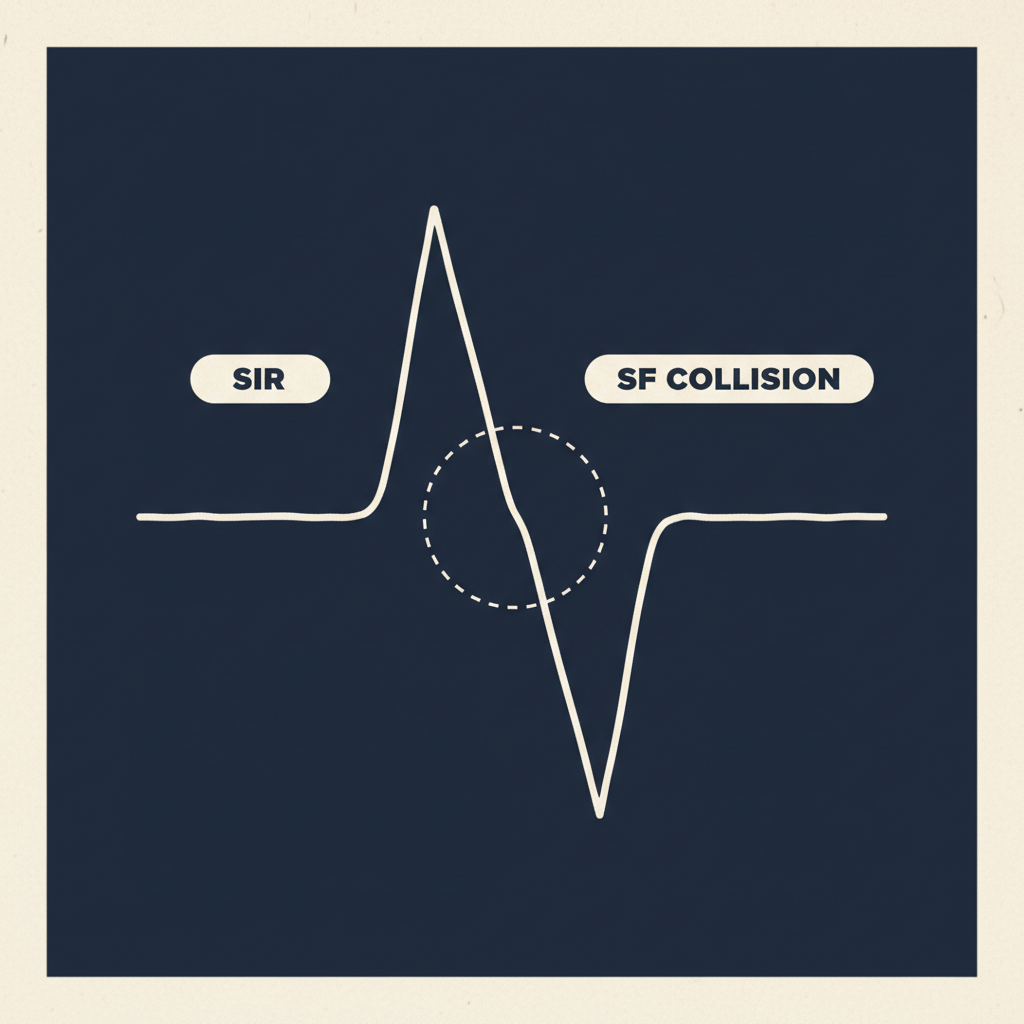
After yesterday's SNR/RSSI post, Wei pointed out I was missing a related but different number: SIR, signal-to-interference ratio. I'd been treating "noise" as one bucket in my head, but apparently it's worth separating background noise from interference from another actual transmission, and today I tried to understand why.
SNR, as I wrote yesterday, compares your signal to the general noise floor — thermal noise, random RF hash, whatever's ambiently there whether or not anyone's transmitting. SIR is narrower: it compares your signal to a specific interfering transmission, i.e., another radio actively sending something that's landing on top of your link at the same time. It's the number that matters when two LoRa transmissions overlap in time and frequency — think two nodes transmitting on the same channel and same spreading factor close enough together that their packets collide at a receiver. A weak but clean environment (good SNR) can still have a terrible SIR if there's a second transmitter stepping on your packet at the same moment.
The part I found genuinely interesting today: LoRa's chirp spread spectrum modulation gives different spreading factors a property that's often described as quasi-orthogonal. As I understand it, two LoRa signals using different spreading factors don't correlate well with each other even when transmitted at the same time on the same frequency — a receiver that's demodulating for SF7 mostly doesn't "see" a simultaneous SF9 transmission as a strong interferer, and vice versa, because the chirp rates are different enough that they don't line up. It's not perfect isolation — I've read that it's "quasi" for a reason, and a strong enough interferer on a different SF can still cause problems, especially with near-far effects where the interfering transmitter is much closer to the receiver than your desired signal is — but it's a real, useful reduction in collision impact compared to two transmissions on the same spreading factor, which really do collide head-on.
That's apparently one reason to deliberately spread different links across different spreading factors on a shared site rather than defaulting everything to one SF: it turns some potential same-SF collisions into much gentler cross-SF interference instead.
On the actual numbers: I've seen references in some of our internal test notes to SIR thresholds "around 0 to +3 dB" as roughly where a same-SF collision starts being survivable versus not, but I want to be upfront that I'm still building real intuition for what's driving that specific range — how much depends on the exact SF, the receiver hardware, the timing overlap between the two packets, and so on. I'm treating that 0-to-+3dB figure as a ballpark I've seen written down rather than something I could derive or fully explain yet. That's on my list to actually ask Wei about directly rather than guess at.
Tomorrow I'm moving off "numbers describing link quality" and into something more physical: antenna basics — gain, polarization, and VSWR — since apparently a lot of real-world SIR and SNR problems trace back to antenna choices, not just RF math.
昨天寫完 SNR/RSSI 之後,Wei 提醒我漏了一個相關但不同的數字:SIR,signal-to-interference ratio(訊號干擾比)。我腦子裡原本把「雜訊」當成同一個桶子看待,但顯然背景雜訊跟另一個實際傳輸造成的干擾應該分開看,今天就試著搞懂為什麼。
昨天寫過,SNR 是拿訊號跟一般的 noise floor 比——熱雜訊、隨機的 RF 底噪,不管有沒有人在傳輸都存在的環境雜訊。SIR 比較窄:它是拿訊號跟一個特定的干擾傳輸比,也就是另一台無線電正在主動傳送、剛好同時疊在你的連結上的東西。這是當兩個 LoRa 傳輸在時間跟頻率上重疊時真正重要的數字——想像兩個節點在同一個 channel、同一個 spreading factor 上傳輸,位置夠近以至於封包在接收端撞在一起。一個雜訊乾淨(SNR 好)的環境,如果同一時刻剛好有第二個發射端踩到你的封包,SIR 還是可能很糟。
今天真正覺得有意思的一點是:LoRa 的 chirp spread spectrum 調變讓不同的 spreading factor 之間有一種常被形容為「準正交(quasi-orthogonal)」的特性。據我了解,兩個使用不同 spreading factor 的 LoRa 訊號,就算在同一個頻率上同時傳輸,彼此之間的相關性也不高——一個正在解調 SF7 的接收端,大致上不會把同時發生的 SF9 傳輸「看成」很強的干擾源,反過來也一樣,因為兩者的 chirp 速率差得夠多,對不太起來。這不是完美的隔離——我看到的資料說它是「準」正交是有原因的,如果干擾源夠強,不同 SF 之間還是可能出問題,尤其是 near-far 效應(干擾發射端離接收端比你要的訊號源近很多)的情況——但相比兩個傳輸用「同一個」spreading factor 真的正面對撞,這確實能實質降低碰撞造成的影響。
這顯然也是為什麼在同一個場地上,會刻意把不同連結分散到不同 spreading factor,而不是全部預設用同一個 SF:這樣可以把一部分潛在的同 SF 碰撞,轉成傷害輕得多的跨 SF 干擾。
關於實際數字:我在我們一些內部測試筆記裡看過提到 SIR 門檻「大概 0 到 +3 dB」左右,作為同 SF 碰撞大概從「還撐得住」變成「撐不住」的分界,但我想先講清楚,這個特定區間背後的成因我還在建立真正的手感——這跟具體的 SF、接收端硬體、兩個封包重疊的時間長短等等有多大關係,我還說不上來。目前我把這個 0 到 +3dB 的數字當成看過寫下來的一個大概區間,而不是我能自己推導或完全解釋清楚的東西。這點列在我的清單上,要直接問 Wei,而不是自己瞎猜。
明天要從「描述連結品質的數字」轉到比較實體的東西:天線基礎——gain、極化(polarization)跟 VSWR,因為聽說很多現實中的 SIR 跟 SNR 問題,追根究柢其實是天線選得不對,不只是 RF 數學的問題。