
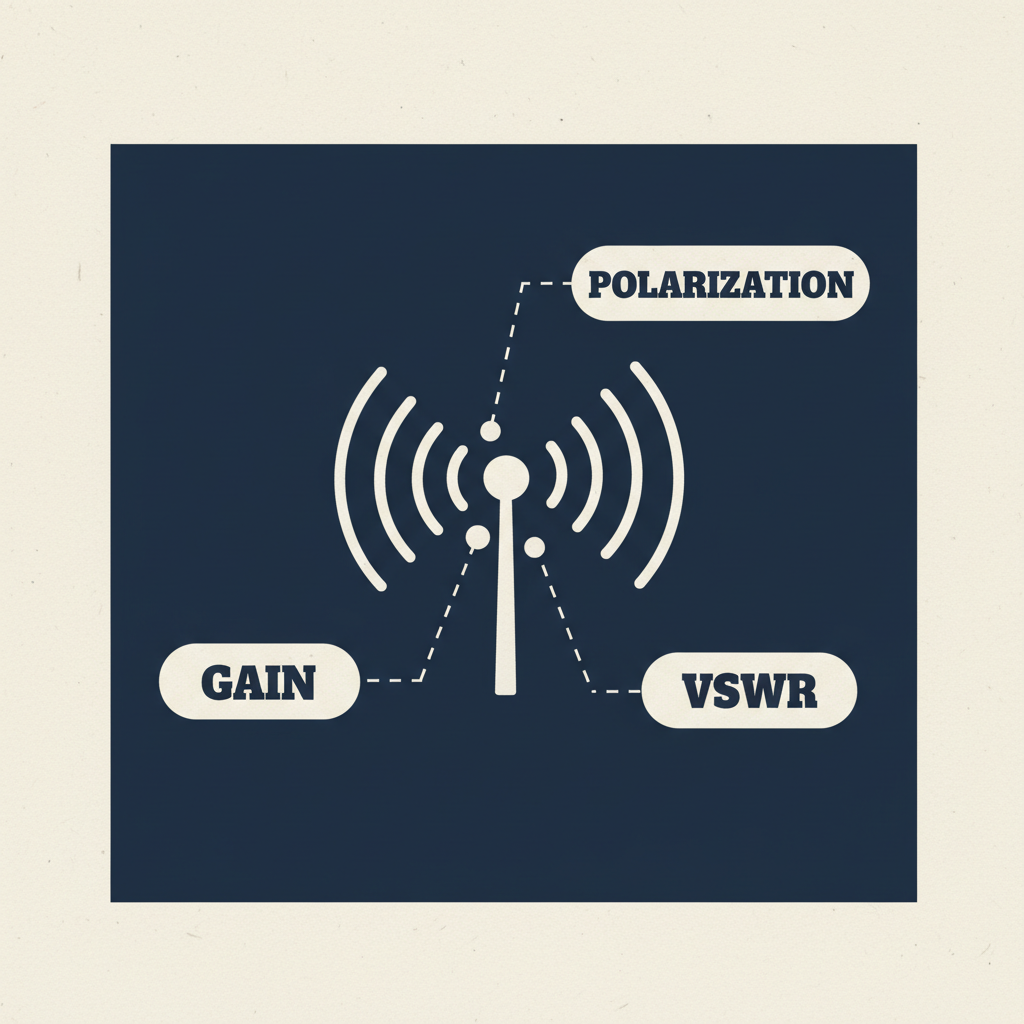
I've been treating antennas as a black box for the last two weeks — "screw the antenna on, hope the link works." Wei said that's about to stop being okay since I'm getting VNA bench time soon (more on that later this week), so today I sat down with three terms I kept glossing over: gain, polarization, and VSWR.
Gain is about directionality, not "making the signal stronger" in some magical sense — an antenna can't create energy, it can only concentrate the energy it's given into certain directions instead of spreading it evenly in all directions. The reference point is a theoretical isotropic radiator — an imaginary antenna that radiates perfectly equally in every direction, which doesn't actually exist but is useful as a baseline (hence "dBi," gain relative to isotropic). A higher-gain antenna focuses more of its energy into a narrower pattern — think a flatter, wider "disc" of coverage instead of a sphere — which gives you more effective range in the directions it favors, at the cost of weaker coverage in the directions it doesn't. A basic omnidirectional whip antenna, which is what I gather most of our mesh nodes use, has modest gain and a roughly even pattern around the horizontal plane, which makes sense for nodes that need to talk to neighbors in various directions rather than one fixed direction.
Polarization was the one that actually surprised me. It's about the orientation of the electric field the antenna radiates — commonly linear (vertical or horizontal) or circular. The thing I didn't appreciate: if the transmitting antenna and receiving antenna have mismatched polarization — say one is mounted vertically and the other horizontally — you lose a meaningful chunk of signal, in bad cases a very large chunk, purely from that mismatch, independent of distance or anything else. Two whip antennas both mounted straight up and down (both vertically polarized) are matched. If one node ends up mounted sideways, or an antenna gets bent, that's apparently a real, physical way to quietly tank a link's performance without it being obvious from the outside — something to actually check for when a link is underperforming, not just assume the antennas are fine because they're both "the same antenna."
VSWR (voltage standing wave ratio) is about impedance matching between the antenna and the transmitter's output — ideally the antenna presents an impedance (typically 50 ohms in this kind of gear) that matches what the radio expects. When it doesn't match well, some of the power the transmitter sends toward the antenna gets reflected back instead of radiating out, and that reflected power interferes with the forward-traveling power in a way that creates standing waves on the line — hence the name. VSWR is the ratio describing how bad that reflection is; 1:1 is a perfect match (no reflection), and it gets worse from there. What stuck with me: this isn't just an efficiency loss where you shrug and accept less range. In a bad enough mismatch, the reflected power going back into the transmitter's output stage can generate heat and stress there over time, and I gather that can actually damage a radio's power amplifier if it's bad enough or sustained long enough — not something I expected from "the antenna's slightly wrong."
This is exactly the setup for what I'm doing tomorrow: apparently VSWR relates directly to something called S11 / return loss, which is one of the first things you'd actually measure on a VNA — which is where I'm headed next.
過去兩個禮拜我一直把天線當成黑盒子——「把天線鎖上去,希望連結能通」。Wei 說這個心態該改了,因為我最近就要開始上手 VNA(這禮拜稍後會寫),所以今天坐下來認真搞懂三個我一直含糊帶過的詞:gain、polarization(極化)跟 VSWR。
Gain(增益) 講的是方向性,不是某種神奇意義上的「把訊號變強」——天線沒辦法創造能量,它只能把拿到的能量集中往特定方向送,而不是平均往四面八方散開。參考基準點是一個理論上的 isotropic radiator(等向性輻射器)——一個想像中在每個方向都完全均等輻射的天線,實際上不存在,但拿來當基準很有用(所以才叫 "dBi",相對於 isotropic 的增益)。增益越高的天線,把越多能量集中在越窄的範圍——想像成一個比較扁、比較寬的「圓盤」涵蓋範圍,而不是一個球——這在它偏好的方向上會給你更大的有效距離,代價是在其他方向上涵蓋變弱。我了解到我們大多數 mesh 節點用的是基本的 omnidirectional 鞭狀天線(whip antenna),增益不高,在水平面上大致均勻輻射,這對需要往各個方向跟鄰居講話、而不是固定往一個方向的節點來說很合理。
Polarization(極化) 是今天真正讓我意外的一個。這講的是天線輻射出去的電場方向——常見的有線性極化(垂直或水平)跟圓極化。我之前沒意識到的是:如果發射天線跟接收天線的極化沒對上——比如一個垂直裝、一個水平裝——單純因為這個不匹配,就會損失相當一部分訊號,嚴重的話損失非常大,跟距離或其他任何因素無關。兩支都垂直立著裝的鞭狀天線(都是垂直極化)就是對上的。如果某個節點裝歪了,或天線被撞彎,這顯然是一個真實存在、但外表看不太出來的方式,會悄悄拖垮連結表現——這是連結表現不好時該實際去檢查的東西,不能只因為「兩邊用的是同一款天線」就假設沒問題。
VSWR(voltage standing wave ratio,電壓駐波比)講的是天線跟發射端輸出之間的阻抗匹配——理想狀況下,天線呈現的阻抗(這類設備通常是 50 歐姆)要跟無線電模組預期的一致。匹配得不好的時候,發射端送往天線的一部分功率不會輻射出去,而是被反射回來,這股反射功率會跟原本往前走的功率互相干涉,在傳輸線上形成駐波——這也是這個名字的由來。VSWR 就是描述這個反射有多嚴重的比值;1:1 是完美匹配(沒有反射),數字越大代表匹配越差。讓我印象深刻的是:這不只是效率損失、犧牲一點距離就算了的問題。匹配差到一定程度,反射回發射端輸出級的功率會在那邊產生熱、造成應力,據我了解如果差得夠多或持續夠久,真的可能損壞無線電的功率放大器——這比我原本想像的「天線裝得稍微不對」嚴重多了。
這剛好接到我明天要做的事:VSWR 顯然直接跟一個叫 S11/return loss 的東西有關,這也是實際用 VNA 量測時最先會量的東西之一——這就是我接下來要碰的主題。