
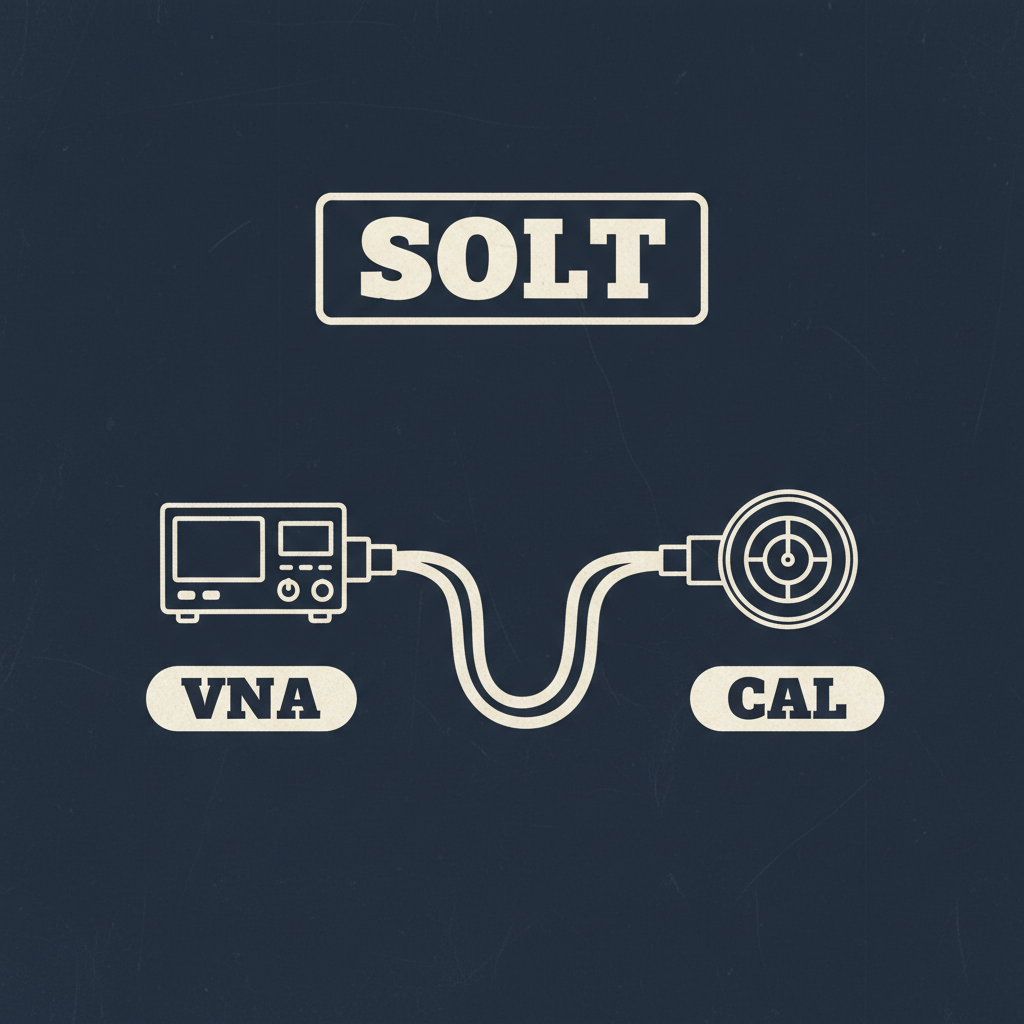
Two weeks in, and I'm finally getting close to real VNA bench time — we're waiting on a Load standard to arrive before I can actually run a full calibration, but Wei had me spend today understanding why calibration is even necessary before I touch the instrument for real, instead of just following a checklist blindly.
A VNA (vector network analyzer) measures how a device responds to RF energy across a range of frequencies — it sends a known stimulus signal in and measures what comes back, both in magnitude and phase (that's the "vector" part — it's not just measuring power like a simple power meter, it's tracking the full complex response). For something like an antenna, one of the first things you'd measure is S11 — how much of the signal sent toward the antenna gets reflected back, at each frequency, which is directly related to the VSWR/impedance-matching stuff I wrote about yesterday. S11 close to zero (in linear terms) or very negative in dB means almost nothing is reflecting — good match. A poor match reflects more.
Here's the problem, and the thing that took me a while to really internalize: whatever cable, connector, and adapter you use to physically connect the VNA to your device under test (DUT) has its own loss and its own phase shift. A cable isn't a perfect, lossless, zero-length wire — it has some insertion loss, some electrical length, and every connector along the way has some tiny reflection of its own. If you just plug in a cable and start measuring, the VNA is faithfully reporting the response of "cable + connectors + your antenna" all mixed together, not the antenna alone. For something like S11, where you're trying to characterize a small reflection, the cable's own imperfections can easily be the same order of magnitude as — or bigger than — the thing you're actually trying to measure. The measurement would be technically real, but not actually telling you what you think it's telling you.
That's what SOLT calibration fixes. You measure four known reference standards, connected right where your DUT would normally go: Short (a connector that reflects essentially all the energy back, with a known, defined phase), Open (also reflects almost everything back, but with a different known phase than the short), Load (a precise 50-ohm termination that should reflect almost nothing — the "perfect match" reference), and Thru (for a two-port setup, a direct connection between the two ports with known, ideally negligible, loss). Because the VNA knows exactly what response each of these standards is supposed to produce in an ideal world, and it can measure what they actually produce through your real cables and connectors, it can mathematically solve for the cable/connector system's own contribution and subtract it out of everything measured afterward. Effectively, calibration moves the "reference plane" — the point the VNA considers to be the true start of the measurement — from the VNA's own ports out to the tip of your test cables, right where the DUT connects.
Skipping this isn't a shortcut, it's just measuring the wrong thing — you'd get numbers, but they'd be dominated by your own test setup rather than the antenna you actually care about. Once the Load standard shows up, I'm planning to actually run through SOLT calibration and then measure S11 on one of our antennas for real — that'll be a good one to write up properly, hopefully with actual numbers instead of just theory.
進入第二個禮拜,終於快要真正上手 VNA 了——我們還在等 Load standard 到貨才能實際跑完整校正,但 Wei 要我今天先搞懂「為什麼」校正是必要的,而不是在真的碰到儀器之前只會盲目照著清單做。
VNA(vector network analyzer,向量網路分析儀)量測的是裝置在一段頻率範圍內對 RF 能量的反應——它送出一個已知的激勵訊號,然後量測回來的東西,同時包含大小跟相位(這就是「vector」的意思——它不是像簡單功率計那樣只量功率,而是追蹤完整的複數響應)。以天線來說,最先會量的東西之一就是 S11——送往天線的訊號在每個頻率上有多少被反射回來,這直接跟我昨天寫的 VSWR/阻抗匹配有關。S11(線性值)接近零,或用 dB 表示是很負的數字,代表幾乎沒有反射——匹配良好。匹配差的話反射就多。
問題來了,這也是我花了點時間才真正想通的地方:不管你用什麼纜線、接頭、轉接頭把 VNA 實體連到待測物(DUT)上,這些東西本身都有自己的損耗跟自己的相位偏移。纜線不是完美、無損耗、零長度的導線——它有一定的 insertion loss、一定的電氣長度,沿路每個接頭也都有自己微小的反射。如果直接接上纜線就開始量,VNA 忠實回報的是「纜線 + 接頭 + 你的天線」混在一起的響應,不是天線單獨的響應。對 S11 這種本來就想量一個很小的反射量的情況來說,纜線本身的不完美很容易跟你真正想量的東西同一個量級、甚至更大。這個量測結果技術上是真的,但實際上並不是你以為它在告訴你的東西。
這就是 SOLT 校正要解決的問題。你去量四個已知的參考標準件,接在 DUT 平常會接的那個位置:Short(幾乎把所有能量都反射回去的接頭,相位已知且固定)、Open(也幾乎全反射回去,但相位跟 Short 不同、同樣已知)、Load(精確的 50 歐姆終端,理論上幾乎不反射任何東西——「完美匹配」的參考)、跟 Thru(在雙埠設定裡,兩個埠之間的直接連接,損耗已知且理想上可忽略)。因為 VNA 知道在理想世界裡這幾個標準件「應該」產生什麼樣的響應,又能量到它們透過你實際的纜線跟接頭「實際」產生了什麼響應,它就能用數學方法把纜線/接頭系統自己的貢獻解出來,然後從之後所有量測結果裡扣掉。實際上,校正做的事情是把「參考平面」——VNA 認定量測真正起點的那個位置——從 VNA 自己的埠口,往外移到你測試纜線的末端,也就是 DUT 實際接上去的那個點。
跳過這一步不是抄捷徑,而是根本量錯東西——你還是會得到一堆數字,但那些數字主要反映的是你自己的測試治具,而不是你真正關心的天線。等 Load standard 一到貨,我打算實際跑一次 SOLT 校正,然後真正去量我們某支天線的 S11——這篇應該值得好好寫一次,希望到時候能寫上實際數字,而不只是理論。