I spend most of my working life thinking about LoRa mesh for industrial sensors — nodes scattered across a site, some of them genuinely far from anything, reporting data over a link budget that has to survive walls, distance, and weather. So when Matter and Thread kept coming up in smart-home news over the last couple of years, I finally sat down and read through how they actually work, out of plain curiosity about a well-known standard from a completely different corner of IoT. This isn't a "should Siliqs adopt Matter" post — it's me comparing notes with a neighboring field.
What Matter and Thread actually are
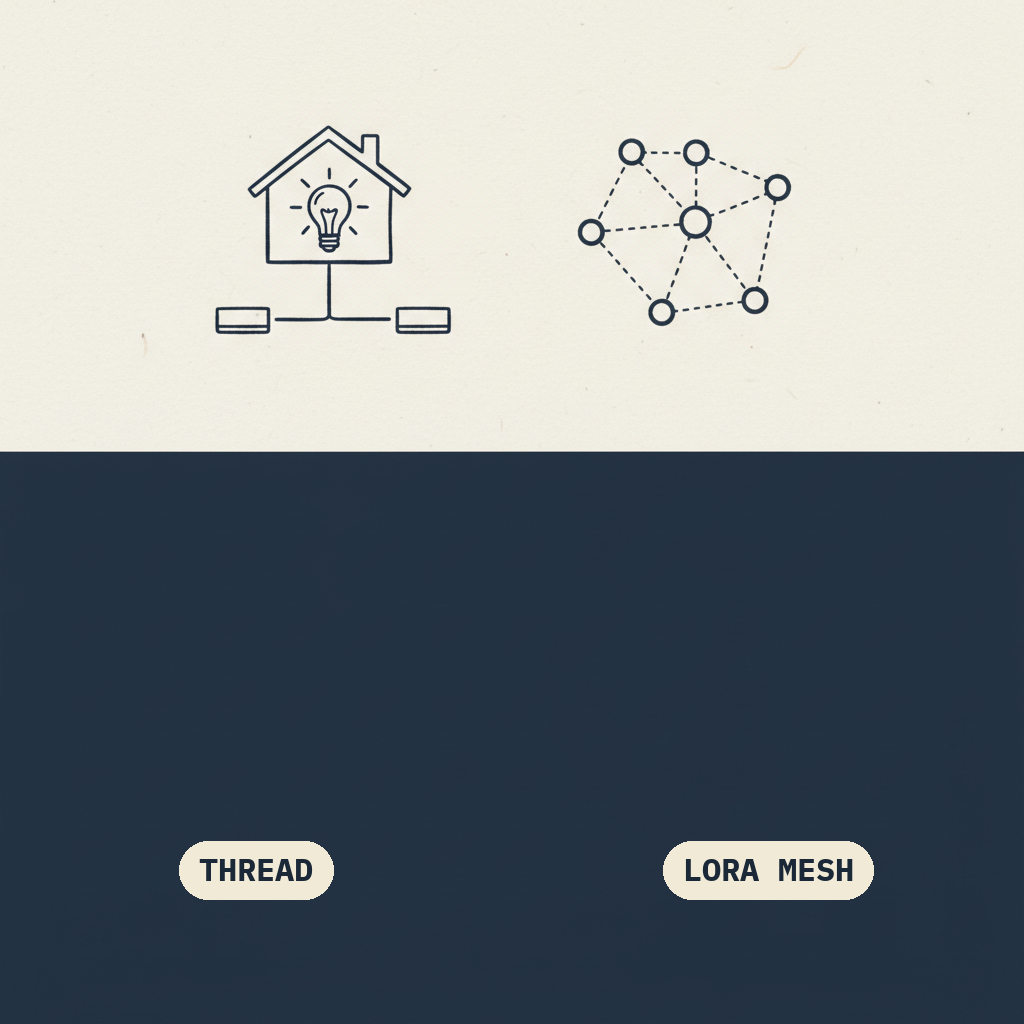
Thread is a low-power mesh networking protocol, built on IPv6 and 802.15.4 radio, designed for short-range, in-building device networks — think light bulbs, door locks, sensors, thermostats all talking to each other and to a border router inside a home. Matter sits on top as an application-layer standard: it defines how devices describe themselves and how they get controlled, independent of which underlying radio carries the bits (Thread is the common one, but Matter can also ride over Wi-Fi). The whole point of Matter is interoperability — a light switch from one vendor should be able to control a light bulb from a completely different vendor, without either company having to hand-negotiate a partnership. That's a genuinely hard problem in consumer IoT, where fragmentation has been the norm for a decade, and Matter is a serious industry-wide attempt to fix it.
Why it's solving a different problem than what we do
Here's where the comparison gets interesting to me. Thread is optimized for dense, short-range networks — a typical home might have dozens of devices within a hundred feet of each other, all needing reasonably frequent, low-latency communication for things like "turn on the light within a fraction of a second of the switch being pressed." LoRa's entire value proposition points the opposite direction: long range, at the direct cost of low data rate and a duty-cycle-limited air interface. A LoRa mesh node might be reporting a handful of bytes every few minutes from a sensor that's genuinely kilometers from the nearest gateway, tolerating latency that would be completely unacceptable for a light switch.
Put simply: a smart bulb's requirements and an industrial sensor on the far edge of a site have almost nothing in common except the word "wireless." Thread needs density and responsiveness; LoRa needs range and needs to survive on a battery for years while transmitting rarely. Neither radio layer would make sense for the other's job — you couldn't run a whole-house lighting network over LoRa's duty cycle limits, and you couldn't get Thread's short range anywhere close to covering an industrial site's perimeter.
What's actually worth borrowing
Where I do think Matter has something genuinely interesting to offer is conceptual, not physical-layer: the idea of a standardized application layer that's decoupled from the radio underneath. Matter's design explicitly separates "how do we describe and control a device" from "what radio carries the bits," which is a clean way to think about interoperability in general. Our private LoRa mesh is, well, private — we control both ends, so we haven't needed that kind of cross-vendor interoperability layer. But the design philosophy of separating the application model from the transport is worth keeping in mind, because it's the kind of thing that pays off later if you ever need to support more than one radio or open up your protocol to third parties.
I don't think Matter's specific stack has anything to offer our actual RF link — the physics of our problem (range, battery life, low duty cycle) point in the opposite direction from what Thread was built to do, and that's fine, they're solving different problems well. But it was a genuinely useful hour spent reading a spec from outside my usual domain, and I came away with a better appreciation for how deliberately Matter's designers thought about the interoperability problem — even if the radio-layer tradeoffs don't transfer to what we build.
我工作大部分時間都在想工業感測器用的 LoRa mesh——節點散落在一個場域各處,有些真的離什麼都很遠,要在一個必須撐過牆壁、距離、天候的 link budget 裡回報資料。所以過去這一兩年,當 Matter 跟 Thread 一直在智慧家庭新聞裡出現時,我終於坐下來認真讀了它們實際的運作方式,純粹出於對一個來自 IoT 完全不同角落、卻很知名的標準的好奇心。這不是一篇「Siliqs 該不該採用 Matter」的文章——這是我跟一個鄰近領域對一下筆記。
Matter 和 Thread 到底是什麼
Thread 是一個低功耗 mesh 網路協定,建立在 IPv6 與 802.15.4 無線電之上,設計給短距離、室內的裝置網路用——想像燈泡、門鎖、感測器、恆溫器彼此對話,也跟家裡的一個 border router 對話。Matter 疊在上面,是一個應用層標準:它定義裝置如何描述自己、如何被控制,跟底層是哪種無線電在載送位元無關(Thread 是最常見的,但 Matter 也可以跑在 Wi-Fi 上)。Matter 整件事的重點是互通性——一個廠牌的燈開關應該要能控制另一個完全不同廠牌的燈泡,不需要兩家公司私下談合作。這在消費性 IoT 領域是個真正困難的問題,畢竟碎片化已經是十年來的常態,而 Matter 是整個產業一次認真的嘗試,想解決這個問題。
為什麼它解決的是不同的問題
這就是我覺得這個對比有意思的地方。Thread 針對的是密集、短距離的網路做優化——一般家庭可能在一百英尺範圍內就有幾十個裝置,全部都需要相當頻繁、低延遲的通訊,才能做到像「按下開關後幾分之一秒內燈就要亮」這種事。LoRa 整個價值主張指向完全相反的方向:長距離,代價是低資料速率跟受 duty cycle 限制的空中介面。一個 LoRa mesh 節點可能每隔幾分鐘才回報幾個 byte,而且感測器真的離最近的 gateway 有好幾公里遠,能容忍的延遲對一個燈開關來說根本不能接受。
講白一點:一顆智慧燈泡的需求跟一個場域最外圍的工業感測器,除了都用「無線」這個詞之外幾乎沒有共通點。Thread 需要密度跟即時反應;LoRa 需要距離,而且要靠電池撐好幾年、同時很少發送。這兩層無線電互換角色都說不通——你沒辦法在 LoRa 的 duty cycle 限制下跑一整棟房子的照明網路,也沒辦法讓 Thread 的短距離覆蓋一個工業場域的外圍範圍。
真正值得借鏡的東西
我認為 Matter 真正提供了有意思的東西,是概念層面,而不是實體層——也就是「標準化應用層跟底下無線電解耦」這個想法。Matter 的設計明確把「我們如何描述跟控制一個裝置」跟「哪種無線電在載送位元」這兩件事分開,這是思考互通性問題的一種乾淨方式。我們的私有 LoRa mesh,嗯,就是私有的——我們自己控制兩端,所以一直沒有需要那種跨廠商互通層。但是把應用模型跟傳輸層分開的這種設計哲學,值得放在心上,因為如果哪天你需要支援不只一種無線電、或是把協定開放給第三方,這種思路日後會有回報。
我不覺得 Matter 具體的技術堆疊對我們實際的 RF 連結有什麼幫助——我們問題的物理限制(距離、電池壽命、低 duty cycle)指向的方向跟 Thread 設計的目標完全相反,這也沒關係,它們各自把不同的問題解得很好。但花一個小時讀一份來自我平常領域之外的規格書,確實收穫不小,我對 Matter 設計者處理互通性問題那種刻意的思考方式有了更多欣賞——即便無線電層的取捨沒辦法套用到我們做的東西上。