
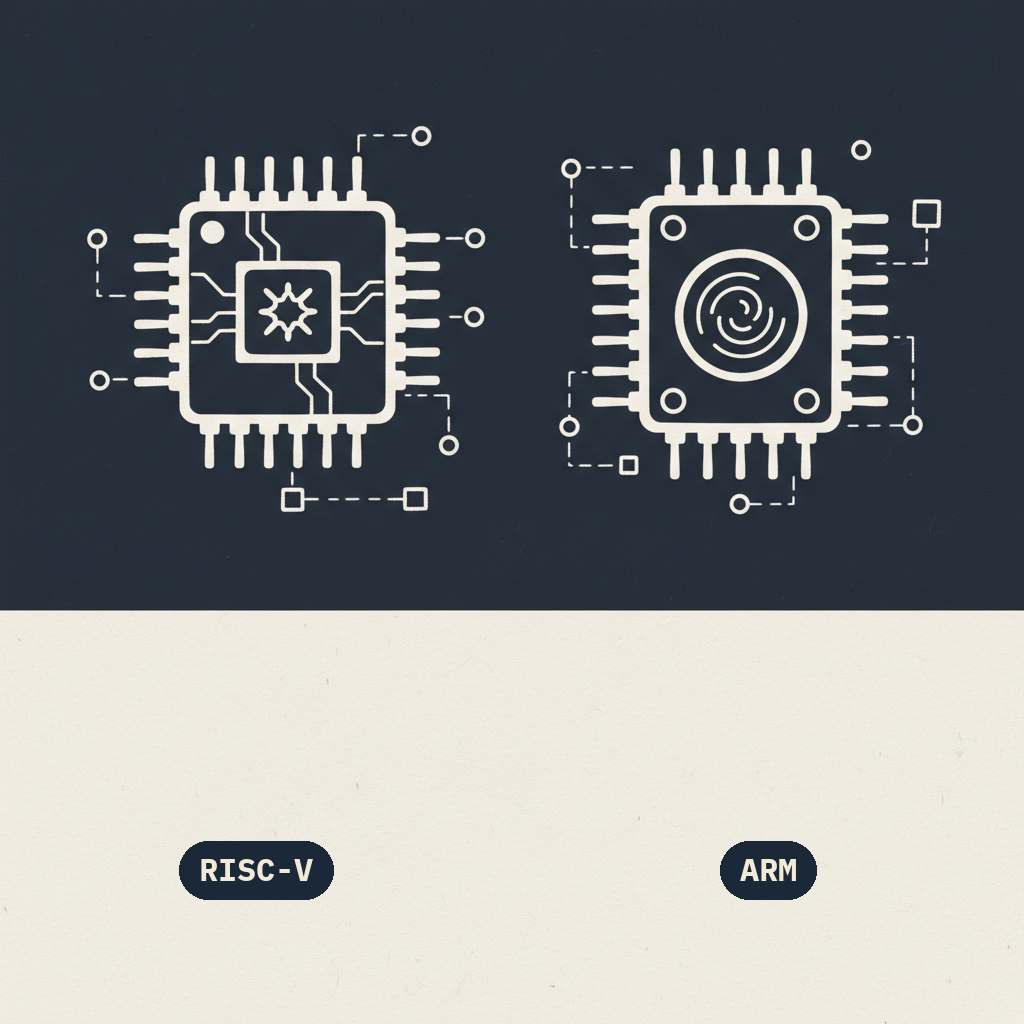
Every IoT node we build runs on an Arm Cortex-M part, and honestly that's true of most of the industry — it's the default answer to "what MCU are we using" so often that I sometimes forget it's a choice rather than a given. So when RISC-V kept coming up in conference talks and vendor newsletters over the past couple of years, I decided to actually spend some time understanding what the architecture offers and whether it's something worth tracking. This is me being curious about the silicon landscape, not a signal that we're moving anything off Cortex-M.
The pitch, and why it's appealing
RISC-V's core idea is an open instruction set architecture — nobody owns it, nobody licenses it, and anyone can implement a core against the spec without paying a per-core royalty to an IP vendor. That's a meaningfully different business model from Arm's, where a chip vendor pays for the right to put a Cortex-M core in silicon. For a chip company, that changes the cost structure of building a part. For the ecosystem more broadly, it means more organizations can experiment with custom cores, extensions, and instruction set tweaks without needing an architecture license.
That openness has attracted real interest — university research groups, hyperscalers building custom silicon, and increasingly commercial MCU vendors shipping RISC-V-core parts as alternatives to their Cortex-M lineups, sometimes at a lower price point since there's no licensing cost baked in. The vendor ecosystem has grown from "mostly academic curiosity" to "a real number of production chips you can actually buy" over the last several years, and that trajectory is what got my attention.
Where the reality check comes in
Here's the thing an open ISA doesn't automatically solve: tooling maturity. RISC-V is a specification, and a specification doesn't ship you a debugger, an RTOS port, or a driver library. Each vendor's actual chip — with its specific set of extensions, its specific peripheral set, its specific SDK — is what you actually have to work with, and that maturity varies enormously from one vendor to the next. Some have genuinely solid toolchains built on GCC/LLVM with working OpenOCD debug support. Others feel like you're the first external person to try a given code path.
Compare that to Cortex-M, where the ecosystem head start is enormous. Decades of accumulated SDKs, RTOS ports, HAL libraries, debugger support across every major vendor, forum threads with the exact error message you're staring at, engineers who've already solved the problem you're about to hit. That's not something an open ISA erases overnight, no matter how good the architecture itself is on paper. Ecosystem maturity is largely a function of time and adoption volume, and Cortex-M has a multi-decade lead.
There's also a scale-of-decision issue worth naming honestly: switching a firmware team from C to Rust is a language decision — you can do it module by module, and the existing toolchain mostly still applies. Switching MCU architecture is a much bigger decision. It touches your build toolchain, your debugger workflow, your RTOS port (if you use one), every vendor driver, and every bit of hard-won tribal knowledge your team has about quirks in a specific silicon family. That's not a decision you make because an architecture is philosophically appealing — it has to be justified by a concrete, current advantage for the specific chip you'd actually use.
Where I've landed
RISC-V's trajectory is genuinely interesting to watch, and I expect the tooling gap to keep narrowing as adoption grows — that's usually how these things go. But "the ISA is open" and "this specific vendor's chip has a debugger experience as smooth as what I already have" are two different questions, and only the second one actually matters when you're picking a part for a product. Right now, for us, Cortex-M's ecosystem maturity is still the more defensible choice, and to be clear, evaluating RISC-V has been my own curiosity project, not anything on our roadmap. I'll keep half an eye on it, because I do think the gap is closing — just not there yet for what we build.
我們做的每一顆 IoT node 都跑在 Arm Cortex-M 上,老實說整個業界大概也是如此——它是「我們要用哪顆 MCU」這個問題的預設答案,答到我有時候會忘記這其實是個選擇,而不是理所當然。所以過去這一兩年,當 RISC-V 一直在研討會與廠商電子報裡冒出來,我決定真的花點時間搞懂這個架構到底提供了什麼,值不值得追蹤。這是我對晶片產業版圖的好奇,不是我們要把什麼東西從 Cortex-M 上搬走的訊號。
賣點,以及它吸引人的地方
RISC-V 的核心概念是一個開放的指令集架構——沒有人擁有它,沒有人要授權它,任何人都可以照著規格實作一顆核心,不用付每顆核心的權利金給某個 IP 廠商。這跟 Arm 的商業模式有實質差異,在 Arm 的模式裡,晶片廠商要付錢才能把 Cortex-M 核心放進矽片。對晶片公司來說,這改變了做一顆晶片的成本結構。對更廣的生態系而言,這代表更多組織可以在不需要架構授權的情況下,去實驗客製核心、擴充功能、指令集調整。
這種開放性確實吸引了不少真實興趣——大學研究團隊、正在做客製晶片的雲端巨頭,還有越來越多商用 MCU 廠商推出 RISC-V 核心的產品,作為 Cortex-M 產品線的替代選項,有時候因為省下授權成本,價格點也更低。過去幾年間,這個廠商生態系已經從「大多是學術性質的好奇心」成長為「有相當數量、你真的可以買到的量產晶片」,而這條軌跡就是吸引我注意的地方。
現實會在哪裡打臉你
有一件事開放 ISA 並不會自動幫你解決:工具鏈成熟度。RISC-V 是一份規格書,規格書不會附贈你除錯器、RTOS 移植版,或驅動程式庫。每家廠商實際的晶片——帶著它特定的擴充指令組合、特定的周邊裝置、特定的 SDK——才是你真正要面對的東西,而這個成熟度在不同廠商之間差異極大。有些廠商的工具鏈確實建立在 GCC/LLVM 之上、有可運作的 OpenOCD 除錯支援,相當扎實。有些則感覺你像是第一個試某條程式路徑的外部人士。
拿這個跟 Cortex-M 比,生態系的起跑優勢非常巨大。幾十年累積下來的 SDK、RTOS 移植版、HAL 函式庫、每個主要廠商都有的除錯器支援、論壇上正好貼著你眼前那個錯誤訊息的討論串、已經有工程師先幫你踩過你即將踩到的坑。無論架構本身在紙面上有多好,開放 ISA 都不會一夜之間抹平這個差距。生態系的成熟度,基本上是時間跟採用規模的函數,而 Cortex-M 領先了好幾十年。
還有一個值得老實講清楚的決策層級問題:把韌體團隊從 C 換成 Rust 是個語言層面的決定——你可以一個模組一個模組地做,既有工具鏈大部分還是用得上。換 MCU 架構是個大得多的決定。它會牽動你的建置工具鏈、除錯器工作流程、RTOS 移植(如果你有用的話)、每一個廠商驅動程式,以及你團隊對特定矽片家族怪癖辛苦累積下來的所有經驗。這不是一個因為架構在哲學上很吸引人就能做的決定——它必須由你實際會用的那顆晶片當下的具體優勢來證成。
我目前的結論
RISC-V 的發展軌跡真的很值得關注,我也預期隨著採用度提高,工具鏈的差距會持續縮小——這種事情通常就是這樣發展的。但「這個 ISA 是開放的」跟「這家特定廠商的晶片有跟我現在用的一樣順暢的除錯體驗」是兩個不同的問題,而選晶片給產品用的時候,真正重要的只有第二個問題。目前對我們來說,Cortex-M 生態系的成熟度還是比較站得住腳的選擇,說清楚一點,評估 RISC-V 是我自己的好奇心專案,不是我們路線圖上的東西。我會繼續留意它,因為我確實覺得那個差距正在縮小——只是對我們做的東西來說還沒到那個時間點。